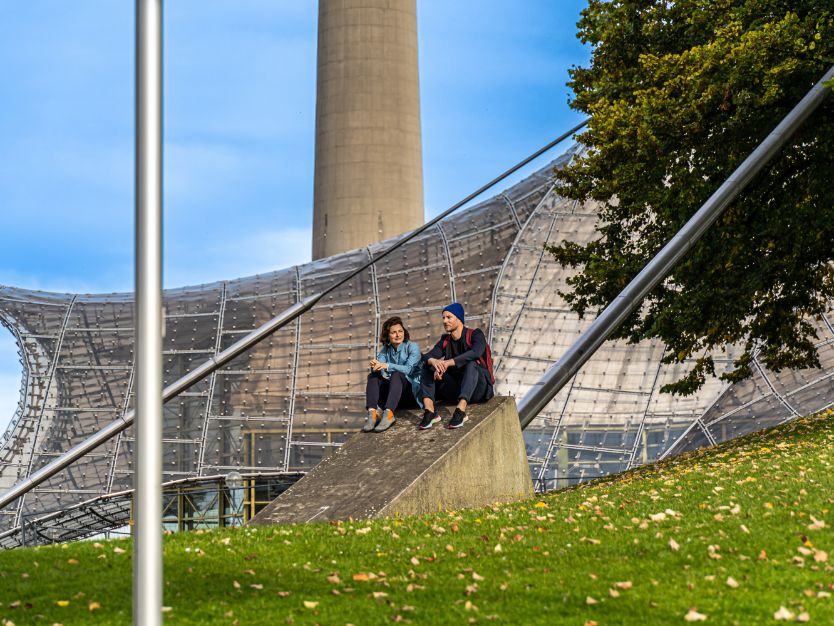
The Olympic Park Ensemble

Many people associate the Olympic Park with a personal story – whether it’s a major concert in the stadium, a sunset on Olympic Hill, a visit to the Tollwood Festival, or memories of a sporting event. The planners had long-term reuse in mind when they designed the Olympic Park. Even back then, Munich was meant to receive a 'park for everyone' in the spirit of sustainability.

An Architectural Masterpiece

The Olympic Park covers an area of approximately 290 hectares. One of its most remarkable features is the seamless blending of interior and exterior spaces, architecture and landscape. At its heart lies the architectural and park landscape with the main sports venues and the iconic floating Olympic roof. The Mittlerer Ring road runs through the park. South of it are the sports facilities, the television tower, the Olympic Lake, and Olympic Hill; to the north are the Olympic Village and the Central University Sports Facility.

The ensemble also includes the ice sports hall and the Olympic Tower, both of which existed before the 1972 Summer Games. On the other side of the Mittlerer Ring lies the residential area of the Olympic Village, including the former men’s and women’s villages, the former cafeteria, and the Ecumenical Church Center. West of the Olympic Village is the Central University Sports Facility, which served as a training and preparation center during the Games and is now the sports campus of the Technical University of Munich.

Arbeiten am Zeltdach Olympiapark 1970_71

A design and engineering masterpiece is the transparent tent roof, which spans the three main sports venues: the Olympic Stadium, the Olympic Hall, and the Swimming Hall. The construction of the tent roof between 1970 and 1971 was a major challenge for everyone involved (see image on the left).
Originally, the roof was intended to be dismantled after the Olympic Games. However, the enthusiastic response from the international press – who saw it as the embodiment of the 'light games' – prevented its removal. In the late 1990s, the roof underwent a major renovation, during which the plexiglass panels were replaced. A new restoration is currently underway to preserve the light-transmitting structure from 1972 for future generations. 

Memorial Sites of the 1972 Olympic Attack

The memorial sites of the 1972 Olympic attack are places of remembrance, mourning, and reflection.

Ecumenical Church Center Frieden Christi

It was the first ecumenical church center in Bavaria – reflecting the spirit of the 1972 Olympic Games: cheerful, open-minded, and democratic.

Olympic Tower

At nearly 300 meters tall including its antenna, the Olympic Tower is Munich’s tallest building. It was constructed between 1965 and 1968, prior to the Olympic Games.

Olympic Village

The Olympic Village was an urban planning experiment of its time. It was designed as a 'city within the city', offering all the functions of daily life in a compact space.

Park Landscape, Olympic Lake, and Olympic Hill

The park was shaped from the rubble of the Second World War. The buildings integrated into the landscape deliberately avoid monumentality and pathos.

The sports venues of the Olympic Park

The main sports facilities are embedded in natural depressions, following early Olympic models – visually inspired by ancient sun sails.

Olympiazentrum Station, Bus Terminal, former Suburban Railway Station

The Olympiazentrum underground station is a listed historic monument.

Tent Roof

The signature feature of the Olympic Park is its transparent tent roof made of acrylic glass. At the time of its construction, it was both a visual and structural sensation.